My comments on the book Imperial Life in the Emerald City: Inside Iraq's Green Zone
The fact that the Iraqi occupation was bungled is not in much doubt anymore, and Rajiv Chandrasekaran documents the mismanagement well. That said, any book that doesn't challenge America's divine right to interfere in the affairs of other countries and not letting them choose for themselves leaves a lot to be desired.
Mismanagement? Yes -- we can all agree on that. But there is a more fundamental problem that has nothing to do with whether the occupation (illegal, of course) was managed or mismanaged, and that is the problem of imperialistic, military aggression and preemptive wars based on highly dubious pretexts (mushroom clouds, democracy etc.)
As a simple thought experiment (not a perfect analogy, but close), imagine a British correspondent wrote a book about the brutal Indian occupation and about how it was being mismanaged. Yes, the British would spend endless hours debating how they were managing their Raj, but as an Indian bearing the brunt of the occupation, I would find the mismanagement arguments rather irrelevant and farcical.
Wednesday, February 03, 2010


Benevolent drug companies? Really?
This is my response to this article titled Drug giant GlaxoSmithKline pledges cheap medicine for world's poor
Whatever their real goals (humane or just a calculated ploy), a few observations below:
The US government already spends around $30 billion a year (for basic bio-medical research) via the National Institutes of Health (NIH). This is a taxpayer subsidy to pharmaceutical companies. The pharmaceutical companies always make it sound like it's all their investment and all their hard work, but $30 billion a year is from us public (the market itself could never generate enough money for research). So how come they still have so many strong patents ? The public has a right (it's not a lousy favor from someone) to the benefits of such funding in the form of cheaper drugs and limitations on patents. The government can even increase the funding via NIH and allow the public to gain even more control over the benefits accrued.
It's not clear to me who "patent pooling" is going to benefit and if there are better options such as allowing developing countries to manufacture generics. If "patent pooling" just means just sharing patents among competing pharmaceutical companies, then it may reduce wasteful duplication of research effort by the companies, but will it ultimately reduce the cost of the drugs the same way generics do?
If you read carefully, the article says that this might actually undermine the generics market. From the article -- "Campaigners privately say the move is remarkable, although they worry that it may undermine the generics industry which currently supplies the cheapest drugs in poor countries." and "Campaigners gave a cautious welcome to GSK's strategy. But Oxfam and Médecins Sans Frontières both said the company should go further and include HIV drugs in the patent pool, and warned that generics companies have always been able to offer lower prices than big pharma, because of their lower production costs."
The pharmaceutical companies will readily outsource "discovery" efforts to Bangalore etc. and reap the benefits of outsourcing, but when it comes to allowing Indian companies to manufacture generics cheaply, they get a heart-attack because it cuts into their profits (the fact that it saves lives is not a priority). The US will generally not purchase generic drugs from other countries where it is cheaper to produce (under the influence of the pharmaceutical industry, of course), and organizations like the WTO etc. will prevent companies in other countries (the standard example is CIPLA/Tamiflu, but there are probably many such examples) from manufacturing generics
In general, we should look at the solutions being provided by pharmaceutical companies (no doubt due to public pressure) and consider their possible benefits, but also stop to consider: "Are there better solutions?"
Sunday, January 10, 2010
Objectified
Objectified is a fairly interesting documentary about the design of objects in our daily lives and the designers who make them. The film features interviews with a variety of influential designers discussing their thoughts about the meaning of design, the objects that get produced, and the relationship between objects, humans, and the environment.
Sustainability gets some brief treatment which can be summarized by Alice Rawsthorn's comment that sustainability is not driven by the designers, rather it's consumer driven -- and that supposedly Walmart has embraced sustainability. If she's using Walmart as a prime example of sustainability, it's quite worrisome. Also, according to Rawsthorn, "design tends to be the indulgent medium of the developed economy and a mature culture." Apparently, other "developing countries" aren't as mature.
Jonathan Ive talks about how incredibly hard design is. Mark Newson heavily criticizes children's products, and can't wait to get rid of his child's high chair. Paolo Antonelli has collected 172 definitions of design. Andrew Blauvelt defines design as anything that is touched by man, transformed by man. Chris Bangle goes on and on and on about the design of the BMW X6.
Dieter Rams makes an interesting statement: "If I had to do something in this world again, I would not want to be a designer anymore, because I believe, in the future, it will be less important to have many things, but more important to exercise care about where and how we live. And to think carefully how we can preserve nature."
Rob walker talks (critically) about how "good design" is considered to be a mark of progress, and how if you can recognize good design, it distinguishes you from all the naive and corny bourgeois of the past -- the past being everything up to that minute. Corporations don't necessarily design what people need, but rather their goal is to simply produce more stuff.
Some objects are downright fetishized such as a BMW X6, a valentine typewriter, and an Alessi spoon that will supposedly stimulate four out of the five senses. There are some interesting discussions on how an object should go beyond its functional aspect and establish a meaningful emotional relationship with the human being. Unfortunately, I think this is just wishful thinking. The novelty of objects dies fast, and any supposedly meaningful relationship with an object is always fleeting and unsatisfactory. In fact, a designer in the film admits that most of the products he's designed will end up in a landfill pretty soon.
The documentary ends with the following quote: "The value, and especially the legitimization of design will be in the future measured in terms of how it can enable us to survive."
Overall, I think the film presents a decent coverage of the various points of view on design, but unfortunately, it also reflects an obsession with materialism, a perceived sense of superiority, and a state of affairs that has a long way to go before it can reach any level of sustainability.
Don't forget to watch the special features on the DVD which includes a whole bunch of interesting interviews.
Wednesday, January 07, 2009
Global Warming and the Arctic Sea-Ice Extent
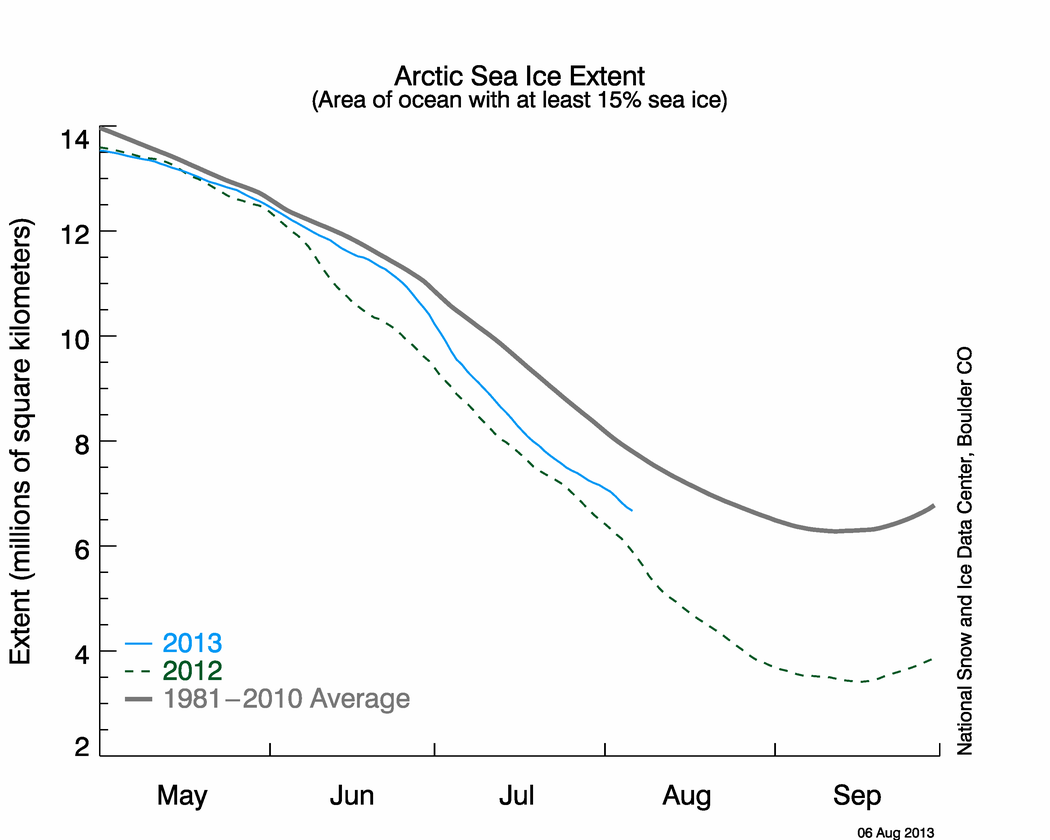
The National Snow and Ice Center has Daily Images on the Sea-Ice Extent (Sea-Ice Extent is defined as Area of Ocean with at least 15% Sea Ice).

You might already be familiar with the "The accelerating loss of the Arctic sea-ice" problem which the graph above makes fairly clear. As mentioned in an earlier post, the Climate Code Red Publication (pdf) released in February 2008 describes in detail the problem of the loss of the Arctic sea-ice (one of the many serious problems described in the publication). As per the report, the loss in summer of all eight million square kilometres of Arctic sea-ice now seems inevitable, and may occur as early as 2010, a century ahead of the Intergovernmental Panel on Climate Change projections. For details, I highly recommend that you make the effort to read the Climate Code Red publication (pdf). If you are a Global Warming skeptic, it might just manage to convince you that the problem is indeed VERY severe.
You might already be familiar with the "The accelerating loss of the Arctic sea-ice" problem which the graph above makes fairly clear. As mentioned in an earlier post, the Climate Code Red Publication (pdf) released in February 2008 describes in detail the problem of the loss of the Arctic sea-ice (one of the many serious problems described in the publication). As per the report, the loss in summer of all eight million square kilometres of Arctic sea-ice now seems inevitable, and may occur as early as 2010, a century ahead of the Intergovernmental Panel on Climate Change projections. For details, I highly recommend that you make the effort to read the Climate Code Red publication (pdf). If you are a Global Warming skeptic, it might just manage to convince you that the problem is indeed VERY severe.
A linear increase in heat in the Arctic Ocean will result in a non-linear, and accelerating, loss of sea ice. --Norbert Untersteiner, Professor Emeritus, University of Washington, July 2006
... the primary issue is whether global warming will reach a level such that ice sheets begin to disintegrate in a rapid, non-linear fashion on West Antarctica, Greenland or both. Once well under way, such a collapse might be impossible to stop, because there are multiple positive feedbacks. In that event, a sea level rise of several meters at least would be expected. --James Hansen, Head of NASA Goddard Institute for Space Studies
The water supplies of dozens of major cities around the world are at risk from a previously ignored aspect of global warming. Within the next few decades rising sea levels will pollute underground water reserves with salt… Long before the rising tides flood coastal cities, salt water will invade the porous rocks that hold fresh water… The problem will be compounded by sinking water tables due to low rainfall, also caused by climate change, and rising water usage by the world’s growing and increasingly urbanised population. --Fred Pearce, English author and journalist specializing in Global Environment issues
Sunday, January 04, 2009
Investment Theory of Politics
Thomas Ferguson is an American political scientist and author who studies and writes on politics and economics, often within an historical perspective. He is a political science professor at the University of Massachusetts Boston.
Thomas Ferguson has written an interesting book titled "Golden Rule: The Investment Theory of Party Competition and the Logic of Money-Driven Political Systems" (1995). In this book, Ferguson breaks completely with traditional voter centered accounts of party politics. In its place he outlines an "investment approach," in which powerful investors, not unorganized voters, dominate campaigns and elections. In effect, Democrats and Republicans are merely the left and right wings of the "Property Party".
Few snippets from the book:
and
.."This does not mean that voters never influence public policy or even that they do not constantly do so. It does imply, however, that their influence on state policy is highly variable and uncertain. In a political system like that of the United States, the costs associated with the control of the state effectively screen out the bulk of the electorate from sustained political intervention".
The policy agenda is attuned to the concerns of the investors and it is distinctly one-sided resulting in "increasingly radical versions of "laissez faire" economics...demands for tax "relief," freedom from regulation, cuts in social welfare expenditures, labor cost reductions and tighter control of increasingly decentralized production systems"and most telling:
"..on all issues affecting the vital interests that major investors have in common, no party competition will take place"For those interested, a preview of the book can be found here
Saturday, December 27, 2008
Two Significant Reports on Climate and Pollution
You might be interested in these 2 significant reports regarding pollution and climate change.
The first one is by the National Environment Trust titled "Toxic Beginnings: Cancer Risks to Children from California's Air Pollution" (published in 2002)
As per the report, in San Francisco, for example, the average infant will exceed the EPA’s lifetime exposure to toxic air pollutants in just 19 days (and a shocking 229 times the acceptable lifetime limit by age 18). The problem is severely compounded by the fact that children face significantly higher risks due to their physiology. Because children breathe more air relative to their body weight, their exposure to air contaminants is higher relative to adults.
Who are the culprits ? According to the report the problem lies in what
California law calls toxic air contaminants, or "TACS." TACS are chemicals that are emitted into the air from many of the same sources that contribute to smog and soot: vehicles, equipment, and factories. Though many of these chemicals contribute to smog, they also independently contribute to cancer, birth defects, and other health problems.
For a quick summary, you can read Jeffrey St. Clair's article @ Counterpunch. Born Under a Bad Sky - Cancerous Air
The second report is called Climate Code Red:The Case for Emergency Action (published in 2008). An excerpt from Wikipedia is included below:
---------
The second report is called Climate Code Red:The Case for Emergency Action (published in 2008). An excerpt from Wikipedia is included below:
Climate Code Red: The Case for Emergency Action is a 2008 book, published by Scribe Publications, which presents scientific evidence that the global warming crisis is worse than official reports and national governments have so far indicated. The book argues that we are facing a "sustainability emergency" that requires a clear break from business-as-usual politics. The authors explain that emergency action to address climate change is not so much a radical idea as an indispensable course we must embark upon. Climate Code Red draws heavily on the work of a large number of climate scientists, including James Hansen.The key themes described at the Climate Code Red website are included below:
- Our goal is a safe-climate future – we have no right to bargain away species or human lives
- We are facing rapid warming impacts: the danger is immediate, not just in the future
- For a safe climate future, we must take action now to stop emissions and to cool the earth
- Plan a large-scale transition to a post-carbon economy and society
- Recognise a climate and sustainability emergency, because we need to move at a pace far beyond business and politics as usual
Thanks to Bill Anderson at CounterCurrents for this link to the Climate Code Red publication
Thursday, December 11, 2008
Humanitarian Interventions and Angelic Powers
Read the Transcript of Noam Chomsky’s speech EUROPE AND AMERICA AS UNDERWRITERS OF THE INTERNATIONAL ORDER at the Institute of European Affairs, 19 January 2006. For full transcript, see here
Chomsky speaks about so called "Humanitarian Interventions". He discusses the classic essay on humanitarian intervention. That’s John Stuart Mill’s essay on humanitarian intervention [J.S. Mill, "A Few Words on Non-Intervention," Fraser's Magazine, December 1859.]
I found this bit about the British Raj interesting.
John Stuart Mill’s immediate concern was India, and he was calling for the expansion of the occupation of India to several new provinces. The timing of the article is quite revealing. It appeared in 1859. That’s immediately after what was called in British history the ‘India mutiny’: the Sepoy rebellion [in 1857], which Britain put down with extreme savagery and brutality. This was very well known in England. There were parliamentary debates – huge controversy over it. There were people who opposed it: Richard Cobden, a real committed liberal, and a few others. Mill knew all about it. He was a corresponding secretary of the East India Company, and was following it all closely. The purpose of the expansion of British power over India, as he knew, was to try to obtain a monopoly over opium so that England could somehow break into the Chinese market. They couldn’t sell goods to China because, as they complained, Chinese goods were comparable and they didn’t want British goods. So the only way to break into the Chinese market was by gunboats and to force them to become a nation of opium addicts at the point of a gun and by obtaining a monopoly of the opium trade – didn’t quite make it, American merchants got a piece of it – they could compel Chinese to become opium addicts and gain access to Chinese markets. And in fact he was writing right at the time of the Second Opium War [from 1856 to 1860], which achieved that. Britain established the world’s most extensive narco-trafficking enterprise; there’s never been anything remotely like it. Not only were they able to break into China for the first time, but also the profits from opium supported the Raj, the costs of the British Navy, and provided very significant capital which fuelled the industrial revolution in England.
Subscribe to:
Posts (Atom)