Showing posts with label Global Warming. Show all posts

Wednesday, January 07, 2009

Global Warming and the Arctic Sea-Ice Extent

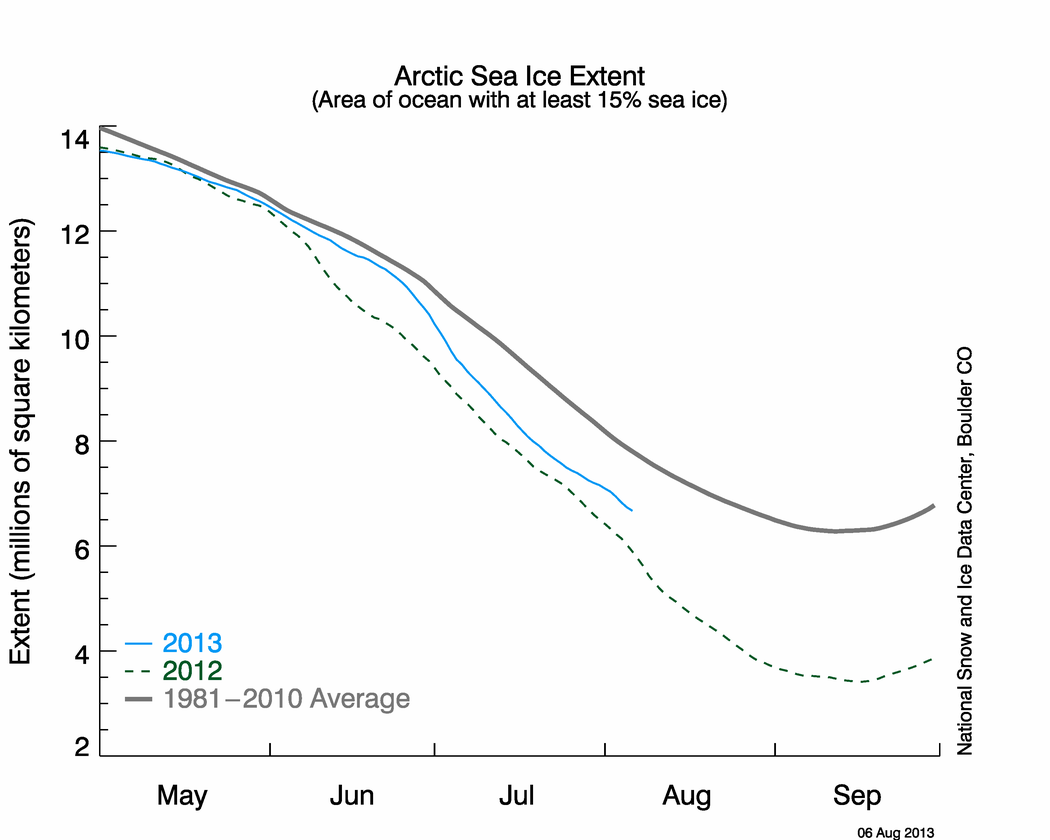
The National Snow and Ice Center has Daily Images on the Sea-Ice Extent (Sea-Ice Extent is defined as Area of Ocean with at least 15% Sea Ice).


You might already be familiar with the "The accelerating loss of the Arctic sea-ice" problem which the graph above makes fairly clear. As mentioned in an earlier post, the Climate Code Red Publication (pdf) released in February 2008 describes in detail the problem of the loss of the Arctic sea-ice (one of the many serious problems described in the publication). As per the report, the loss in summer of all eight million square kilometres of Arctic sea-ice now seems inevitable, and may occur as early as 2010, a century ahead of the Intergovernmental Panel on Climate Change projections. For details, I highly recommend that you make the effort to read the Climate Code Red publication (pdf). If you are a Global Warming skeptic, it might just manage to convince you that the problem is indeed VERY severe.
A linear increase in heat in the Arctic Ocean will result in a non-linear, and accelerating, loss of sea ice. --Norbert Untersteiner, Professor Emeritus, University of Washington, July 2006

... the primary issue is whether global warming will reach a level such that ice sheets begin to disintegrate in a rapid, non-linear fashion on West Antarctica, Greenland or both. Once well under way, such a collapse might be impossible to stop, because there are multiple positive feedbacks. In that event, a sea level rise of several meters at least would be expected. --James Hansen, Head of NASA Goddard Institute for Space Studies

The water supplies of dozens of major cities around the world are at risk from a previously ignored aspect of global warming. Within the next few decades rising sea levels will pollute underground water reserves with salt… Long before the rising tides flood coastal cities, salt water will invade the porous rocks that hold fresh water… The problem will be compounded by sinking water tables due to low rainfall, also caused by climate change, and rising water usage by the world’s growing and increasingly urbanised population. --Fred Pearce, English author and journalist specializing in Global Environment issues

Saturday, December 27, 2008

Two Significant Reports on Climate and Pollution

You might be interested in these 2 significant reports regarding pollution and climate change.

The first one is by the National Environment Trust titled "Toxic Beginnings: Cancer Risks to Children from California's Air Pollution" (published in 2002)

As per the report, in San Francisco, for example, the average infant will exceed the EPA’s lifetime exposure to toxic air pollutants in just 19 days (and a shocking 229 times the acceptable lifetime limit by age 18). The problem is severely compounded by the fact that children face significantly higher risks due to their physiology. Because children breathe more air relative to their body weight, their exposure to air contaminants is higher relative to adults.
Who are the culprits ? According to the report the problem lies in what

California law calls toxic air contaminants, or "TACS." TACS are chemicals that are emitted into the air from many of the same sources that contribute to smog and soot: vehicles, equipment, and factories. Though many of these chemicals contribute to smog, they also independently contribute to cancer, birth defects, and other health problems.
For a quick summary, you can read Jeffrey St. Clair's article @ Counterpunch. Born Under a Bad Sky - Cancerous Air

---------

The second report is called Climate Code Red:The Case for Emergency Action (published in 2008). An excerpt from Wikipedia is included below:
Climate Code Red: The Case for Emergency Action is a 2008 book, published by Scribe Publications, which presents scientific evidence that the global warming crisis is worse than official reports and national governments have so far indicated. The book argues that we are facing a "sustainability emergency" that requires a clear break from business-as-usual politics. The authors explain that emergency action to address climate change is not so much a radical idea as an indispensable course we must embark upon. Climate Code Red draws heavily on the work of a large number of climate scientists, including James Hansen.The key themes described at the Climate Code Red website are included below:
  • Our goal is a safe-climate future – we have no right to bargain away species or human lives
  • We are facing rapid warming impacts: the danger is immediate, not just in the future
  • For a safe climate future, we must take action now to stop emissions and to cool the earth
  • Plan a large-scale transition to a post-carbon economy and society
  • Recognise a climate and sustainability emergency, because we need to move at a pace far beyond business and politics as usual

Thanks to Bill Anderson at CounterCurrents for this link to the Climate Code Red publication

Saturday, October 07, 2006

Michael Crichton's State of Confusion

If you've ever read Michael Crichton's novel "State of Fear", you'll know that the novel is about a self-important NGO hyping the science of the global warming to further the ends of evil eco-terrorists.

Gavin Schmidt (bio), Earth Institute climate scientist and RealClimate.org contributor refutes several major points made in Michael Crichton's book ....(oddly enough ... apparently Crichton did consult with Gavin Schmidt's lab when researching for his book but didn't "get it")

Some of the main points from the Gavin Schmidt's article as far as I can understand are as follows:

  • The global cooling b/w 1940-1970 can be attributed to factors other than CO2 (these other factors are called "forcings" .. such as land use changes, volcanic aerosols etc.). The more recent global warming cannot by accounted for by forcings (other than CO2)
  • Global cooling in one area doesn't exclude overall global warming since we're talking about the planet wide mean. The whole globe isn't warming uniformly. Crichton uses cooling trends from selective weather stations.
  • Crichton says that the global mean temp. is skewed because of of the Urban heating effect. A correction has already been applied for The 'Urban Heat Island Effect' when calculating global mean temperatures.
  • Jim Hansen's testimony to congress in 1988 is often quoted misleadingly and out of context. The reliability of his climate model is often confused with the unpredictability of the forcings.
  • Sea level is a surprisingly difficult thing to measure. Crichton uses sea-level data in a confusing manner.
  • Crichton claims that climate models differ by 400% in their estimates. That's a misleading statement. The current batch of models have a mean climate sensitivity of about 3 C to doubled CO2 (and range between 2.5 and 4.0 degrees) (Paris meeting of IPCC, July 2004) , i.e an uncertainty of about 30% -- again the confusion is probably related to misleading interpretation of Jim Hansen's testimony. Crichton is confusing variability in the forcings with accuracy of the model predictions (basically Crichton appears to be saying that the model gives results that vary by 400% when the forcings vary -- which is a really obvious statement --- you give different inputs to the model -- it will give you different outputs). What Crichton is missing is that the model is fairly accurate given a specific set of forcings and that the set of forcings is what is variable. If the set of forcings is variable, then how can Crichton conclude that global warming is a non-issue ? The correct conclusion based on the climate models should probably be ...if the forcings go a certain way then global warming may not happen, but if the forcings go another way, then global warming can happen. No one can predict the forcings themselves, so you can't say "global waming is a non-issue"

But don't believe my summary .., here is the link to the original aticle. Draw your own conclusions ...